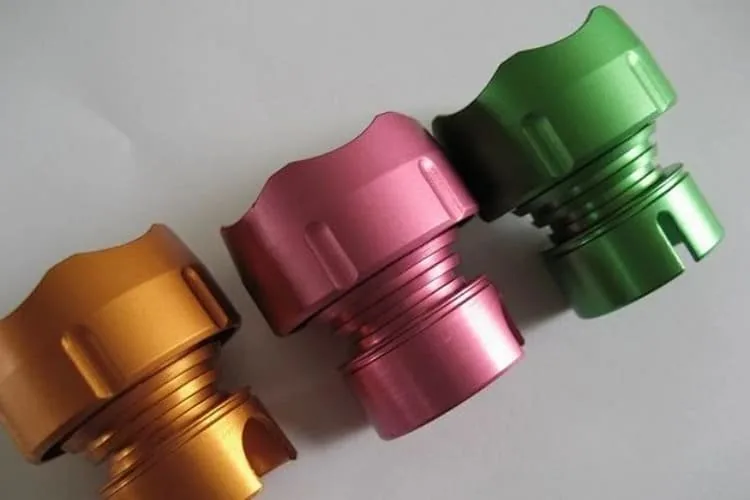
Three 6xxx alloys, all machinable, all anodisable, all cheap enough to use by default. Ask three shops which one to pick and you will get three answers, mostly because each shop is used to whatever is on the shelf locally.
The differences are real but narrow. They show up in four places: how much load the part takes, how it behaves in the cut, how it looks after anodising, and whether the shape you want can be bought as extrusion in the first place.
The short answer
| 6061-T6 | 6082-T6 | 6063-T6 | |
|---|---|---|---|
| Where it is the default | North America, general engineering | Europe, structural and engineering | Architectural and extruded sections |
| Typical tensile strength | About 310 MPa | About 300–340 MPa | About 240 MPa |
| Machinability | Free cutting, good chip break | Free cutting, slightly harder | Softer — can be gummy, watch built-up edge |
| Anodising appearance | Good | Good, slightly less bright | Best — the alloy anodising was designed around |
| Complex extrusions | Harder to extrude | Harder to extrude | Easiest — thin walls and fine detail |
| Pick it when | Strength and availability both matter | You need the European equivalent, or a bit more strength | Looks matter more than load |
Figures are typical values for guidance. Put the alloy, temper and any property requirement on the drawing, and ask for material traceability with the delivery if your customer wants it.
6061-T6: the default for a reason
If a drawing says “aluminium” with no alloy, most shops will use 6061-T6, and most of the time that is the right call. It is strong enough for brackets, plates, housings and fixture bodies, it machines cleanly with good chip breakage, it welds acceptably, and it is stocked in almost every size — plate, bar, block and tube.
Its weak points are specific rather than general: it is not the alloy for a very fine surface after bright anodising, and very thin sections with tight flatness can move on you when you take a lot of material off one face.
6082-T6: the European equivalent, slightly stronger
6082 gets called the European 6061, which is roughly fair. It carries more manganese, which pushes strength a little above 6061 in the T6 temper, and it is the alloy most European plate and bar stock is supplied in. If your drawing comes from a European customer, there is a good chance it already says 6082.
In the cut it behaves much like 6061 — maybe marginally harder on tool wear, not enough to change how you program the job. Where you notice the difference is availability: outside Europe it is not always stocked in the size you want, and a substitution is usually fine mechanically but should be confirmed rather than assumed, because the anodised colour will not match exactly.
6063-T6: when the surface is the point
6063 is the alloy behind most architectural extrusion — window frames, heat sink fins, trim, anything with fine detail and a visible finish. It extrudes into thin walls and complex profiles that 6061 and 6082 will not fill cleanly, and it anodises to a brighter, more even surface.
The trade is strength: roughly 70–80% of 6061-T6 in tension. For a housing that only has to hold its own shape and look good, that is irrelevant. For a bracket carrying load, it is the reason not to use it.
One machining note: 6063 is softer and can smear rather than cut if the tool is dull or the feed is too light. Sharp tools, positive rake and a feed that actually bites keep the surface clean.
What changes in the machine
- Chip control. 6061 and 6082 break chips well; 6063 tends to produce long stringy chips at light feeds. If the job is a deep pocket in 6063, plan for chip evacuation rather than assuming it behaves like 6061.
- Flatness on thin plates. All three move when you remove a lot from one side. Rough both sides, or leave a finishing pass for after the part has relaxed — this is the usual cause of a plate that measures flat on the machine and bowed on the bench.
- Burrs. Softer alloys throw bigger burrs at exit. If a face has to be clean for anodising, say so — edge break is cheaper as a drawing note than as a rework.
- Threads. All three tap fine, but in 6063 a thread in a thin wall is more likely to tear out. If a tapped hole matters, give it more wall or a longer engagement.
How to specify it on the drawing
- Alloy and temper, always. “6061-T6”, not “aluminium”. The temper matters as much as the alloy — the same alloy in O condition is a different material.
- Property requirement, if you have one. If a customer needs a minimum strength, say it, and ask for material traceability with the parts.
- Finish note. If the part is anodised, say which faces are visible. Grain direction and handling marks survive anodising.
- Substitution rule. If 6082 and 6061 are interchangeable for your part, say so on the drawing — it removes a query and often shortens the lead time.
If you are weighing 6061 against a much stronger alloy instead, see 6061 vs 7075, or the material page for CNC machining aluminium.
Frequently asked questions
Can I substitute 6082 for 6061?
Mechanically, usually yes — 6082-T6 is typically a little stronger. Two caveats: check the wall thickness and section you need are available, and if the part is anodised alongside parts in 6061, expect the colour to differ slightly. If substitution is acceptable to you, put it on the drawing so it does not come back as a query.
Which one anodises best?
6063, by a clear margin — it is the alloy architectural anodising is built around. 6061 anodises well and is the usual choice when strength matters too. 6082 is good, with a slightly less bright result. Dyed colours vary between alloys and between batches regardless.
Do these alloys need heat treatment after machining?
Not for most parts. T6 stock arrives already heat treated, and machining does not undo it. Heat treatment becomes relevant if the part is heavily stressed, welded after machining, or if you are starting from an annealed temper and need the strength afterwards.
Why did my aluminium plate go out of flat?
Almost always because material was taken off one face only, releasing stress unevenly. Rough both sides, take balanced cuts, and leave a light finishing pass for after the part has relaxed. Thin, wide plates are the worst case.
Which alloy for a heat sink or a fine-finned extrusion?
6063. It extrudes into thin walls and fine detail that 6061 and 6082 will not fill reliably, and it takes an even anodised finish. You give up tensile strength, which rarely matters for a heat sink.
Do you supply material certification?
Material traceability and inspection reports are available on request — put the requirement on the drawing or in the enquiry and it gets quoted with the job.
Send the drawing
Send a STEP, IGES or DWG model with a dimensioned PDF, the alloy and temper, the quantity and your target date. If you are not sure which of the three suits the part, say what it has to carry and whether anyone sees it — that is usually enough to pick. You get a priced quote within 48 hours in the normal case, with tolerance and lead time stated on it.