Wire EDM Machining Services
Expert wire electrical discharge machining for hardened tool steels, sharp internal corners and tolerances that milling cannot hold. Hardness does not affect cutting speed, so a 60 HRC die steel cuts as easily as annealed 4140.
- Tolerances to ±0.01 mm on critical features (±0.005 mm with skim passes)
- Hardened material machined after heat treatment
- Quotes typically within 48 hours
Quick answer
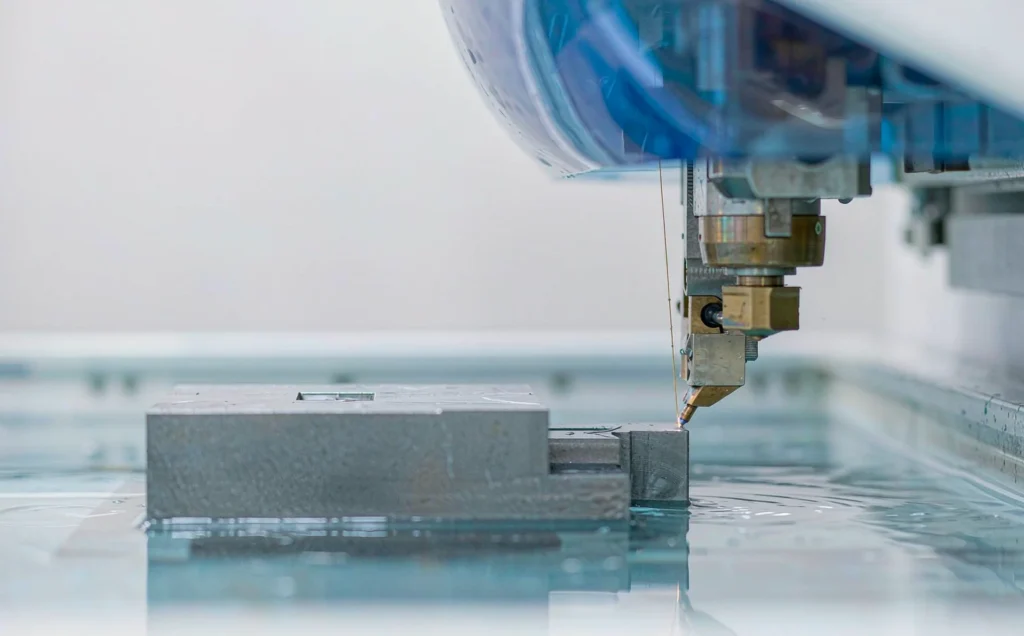
Wire EDM cuts electrically conductive material with a thin brass wire that never touches the workpiece. Material is removed by controlled electrical sparks in deionised water, so hardness is irrelevant — 60 HRC tool steel cuts at the same rate as annealed 4140. That single property makes wire EDM the right answer in three situations: when the material is too hard to mill economically, when the geometry has sharp internal corners no end mill can produce, or when a tolerance has to be held over a long, thin cut where a milling tool would deflect.
We quote wire EDM work within 48 hours in the normal case and run it alongside CNC milling, CNC turning and 5-axis machining, so a part that needs two processes still moves through as one job with one inspection report.
Wire EDM Capability
What the process holds routinely, and where it needs a conversation first.
Standard Tolerance
±0.01 mm
Held routinely on through-cuts and profile work.
High Precision
±0.005 mm with skim passes
Achievable on shorter cuts with skim passes. Mark which features need it.
Surface Finish
Ra 0.4 – 1.6 µm
Multiple skim passes improve finish and remove the recast layer. Ra 0.2 µm on request.
Corner Radius
~0.13 mm
Set by half the wire diameter plus the spark gap — far sharper than any end mill.
Minimum Slot
~0.30 mm
Using 0.20 mm or 0.25 mm wire on fine slots and splines.
Taper
Up to 30°
Independent top and bottom wire movement for mould inserts and extrusion dies.
When wire EDM beats milling
Six situations where the spark process wins on cost, accuracy or both.
| Situation | Why wire EDM wins |
|---|---|
| Material above ~45 HRC | Cutting speed is unaffected by hardness. Milling the same part needs slow feeds, expensive tooling and frequent tool changes. |
| Sharp internal corners | An end mill leaves a radius equal to its own corner. A 0.25 mm wire leaves about 0.13 mm, so near-square internal corners are achievable. |
| Tolerance under ±0.01 mm over a long cut | The wire is guided top and bottom and cuts with almost no lateral force, so there is no tool deflection to compensate for. |
| Thin walls and delicate ribs | No cutting force means thin sections do not bend away from the tool. |
| Small slots and fine splines | Slot widths down to roughly 0.3 mm are practical with fine wire. |
| Parts already heat treated | Finish-machine after hardening instead of re-machining, avoiding distortion from a second heat treatment. |
How the process works
A brass wire, typically 0.20 to 0.30 mm in diameter, runs continuously between an upper and a lower guide while the workpiece is fed past it on a CNC table. Deionised water flushes the gap and acts as the dielectric; a voltage between wire and part creates sparks that vaporise a thin layer of material. Because nothing mechanical touches the part, there is no cutting force to deflect the wire or the workpiece — which is why thin, tall and hardened features come out accurate.
The wire is used once and discarded, so the cut is always made with a fresh, unworn tool. The trade-off is speed: material removal is measured in square millimetres per minute, not cubic centimetres. That makes wire EDM economical for profiles and through-cuts, and uneconomical for removing bulk material. Standard practice is to mill or turn the part close to shape first, then wire cut only the features that need the accuracy.
Materials we wire cut
Any conductive material, hardened or not. Common jobs include tool steels such as A2, D2, O1 and H13 at full hardness, stainless steel in 304, 316 and 17-4PH, titanium Ti-6Al-4V, and tungsten carbide for punches and dies.
Cutting speed depends on the material melting point and conductivity, not its hardness — so carbide is slow while hardened steel is fast. Non-conductive ceramics and plastics cannot be wire cut; for those, see engineering plastics.
Design tips that reduce cost
Small decisions on the drawing that cut hours off the machine time.
- Use the largest wire the geometry allows — a 0.30 mm wire cuts roughly twice as fast as 0.20 mm and breaks far less often.
- Specify skim passes only where finish matters. One skim is usually enough for Ra 0.8 µm; three skims can triple cycle time.
- Leave a start hole or allow an open path — every closed internal profile needs a threaded start hole. Tell us where it may go.
- Avoid very tall, thin sections. Above roughly 10:1 height-to-thickness the wire can wander in the flushing gap.
- State the critical surfaces separately. We can hold ±0.005 mm on two bores and ±0.05 mm elsewhere on the same part — that is normal and much cheaper.
- Plan for the recast layer on fatigue-critical parts; skim passes or a light surface finish remove the re-solidified surface.
Frequently Asked Questions
Answers to the questions we get asked most about this process.
How much does wire EDM cost compared with milling?
Per hour, wire EDM is more expensive, but it often wins on total part cost for hardened materials, because it removes the separate hardening-distortion correction step and eliminates the cost of carbide tooling on hard stock. On soft aluminium, milling is almost always cheaper. Send both options to us and we will quote the one that actually costs less.
Can you wire cut a part that has already been hardened?
Yes, and that is the most common reason customers choose the process. Machine the part to near-net shape, heat treat, then wire EDM the critical features to final size. There is no distortion from finish machining.
What is the smallest feature you can produce?
Around 0.3 mm slot width with 0.20 mm wire. Below that, wire breakage risk rises and lead time becomes unpredictable.
Do you provide inspection reports?
Yes, on request. Dimensional reports against your drawing are available for any job, and we sign an NDA before receiving files if you need one.
What tolerances do you hold if my drawing says nothing?
Features without a specific callout follow ISO 2768-m. If a drawing calls out ±0.005 mm everywhere, cost rises sharply — mark only the features that genuinely need it.
Can you combine wire EDM with milling or grinding?
Yes. Most wire EDM jobs we run start as a milled or turned blank. We plan the sequence so the part arrives at the wire machine already close to shape, and finish with grinding if a face still needs to be flat or round.
Typical applications
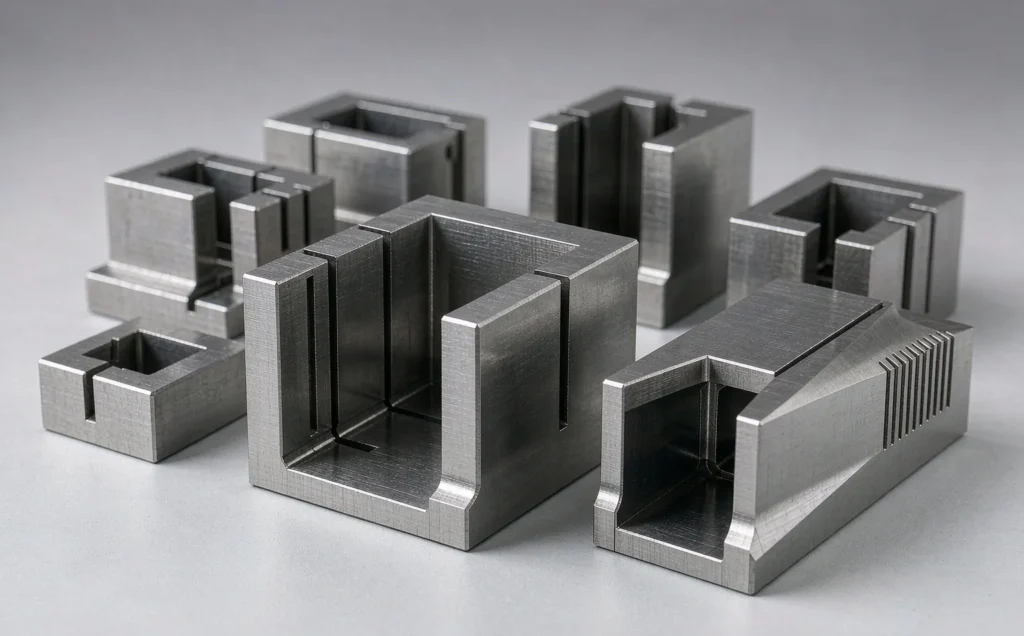
Precision tooling and die inserts, extrusion die openings, splines and internal profiles in hardened steel, electrode stock for sinking EDM, medical and laboratory fixture components, and low-volume production parts where a hard material rules out conventional cutting.
Most work ships in two to four weeks depending on quantity and finish requirements; urgent jobs are handled case by case.
Ready to Start Your Project?
Send drawings in STEP, IGES or DWG. You get a priced quote within 48 hours in the normal case, with tolerance and lead time stated up front.