CNC Grinding Services
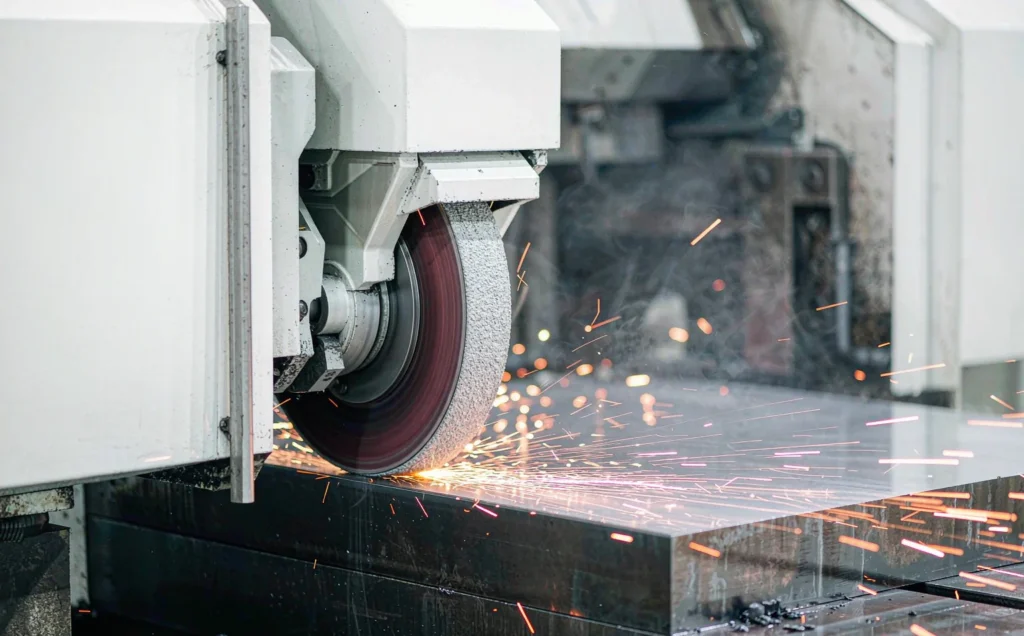
Surface, cylindrical and internal grinding for parts that need micron-level flatness, roundness and surface finish — the finishing step when a feature has to be truer than milling or turning can hold.
- Tolerances to ±0.002 mm
- Surface finish to Ra 0.1 µm
- Hardened steel up to 65 HRC
Quick answer
CNC grinding is the finishing step when a feature needs to be flat, round or square to a level that milling and turning cannot reliably hold — typically tighter than ±0.005 mm, or a surface finish finer than Ra 0.4 µm. It removes material with an abrasive wheel in very small increments, which is why it is slow but extremely predictable, and why it works on material too hard to cut with a tool bit.
We quote grinding work within 48 hours in the normal case and handle it as part of the same job as milling and turning, so you get one point of delivery and one inspection report rather than coordinating two suppliers.
Which type of grinding does your part need?
The four processes we run most, and what each one is for.
| Grinding type | Best for | Typical result |
|---|---|---|
| Surface grinding | Flat faces, shoulders, die and fixture plates | Flatness within 0.005 mm over 300 mm; Ra 0.4 µm or better |
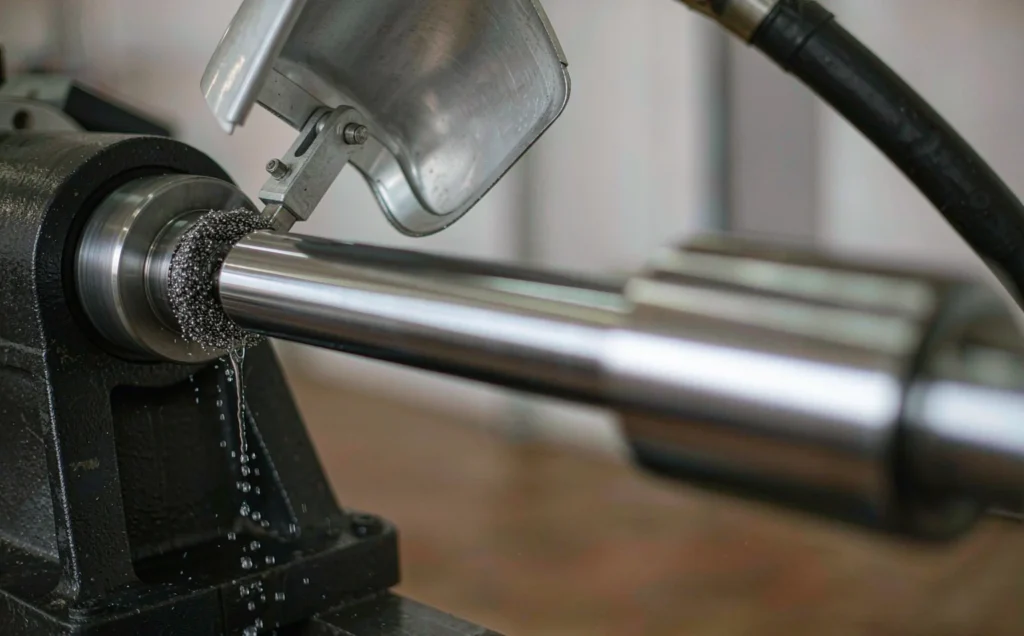
| Cylindrical (OD) grinding | Shafts, pins, rollers, bearing journals | Roundness within 0.002 mm; size held to ±0.002 mm |
| Internal (ID) grinding | Precision bores, bearing seats, hydraulic sleeves | Round bore to ±0.003 mm with good straightness |
| Centreless grinding | High volume pins and shafts without centres | Fast, consistent diameter on simple cylindrical parts |
| Tool and cutter grinding | End mills, reamers, form tools, inserts | Geometry restored or produced from solid carbide |
Grinding Capability
Numbers we hold routinely on ground features.
Dimensional Tolerance
±0.002 mm
On ground features with stable setups.
Flatness
0.005 mm / 300 mm
Depends on part rigidity and support during grinding.
Roundness
0.002 mm
Cylindrical grinding between centres or chucked.
Surface Finish
Ra 0.1 – 0.4 µm
Finer than any cutting process can produce.
Hardened Material
Up to 65 HRC
Grinding is the standard way to finish hardened steel.
Work Envelope
1000 × 400 mm
Surface grinding; cylindrical work up to 300 mm diameter.
Grinding compared with other finishing methods
Use the least precise process that meets the requirement — every step down costs more per part.
| Method | Realistic tolerance | Surface finish | When to choose it |
|---|---|---|---|
| CNC milling and turning | ±0.01 mm | Ra 0.8 – 1.6 µm | Default for almost everything — fastest and cheapest |
| Wire EDM | ±0.005 mm | Ra 0.4 – 1.6 µm | Hardened material, sharp internal corners, through profiles |
| Grinding | ±0.002 mm | Ra 0.1 – 0.4 µm | Flatness, roundness or finish beyond what cutting can hold |
| Lapping and honing | ±0.001 mm | Ra 0.05 µm and finer | Sealing faces, gauge blocks, ultra-flat surfaces |
How grinding holds such tight numbers
An abrasive wheel removes material in increments of a few microns, and the wheel is dressed regularly so its shape stays true. Because each pass removes so little, the process is largely insensitive to hardness — a 60 HRC die steel and a soft mild steel grind at similar rates, which is the opposite of what happens with a cutting tool. The surface left behind has no tool marks in the conventional sense, just the fine pattern of the abrasive grains.
The cost of that precision is cycle time. Grinding removes material perhaps a hundred times more slowly than milling, which is exactly why you grind the faces that need it and machine everything else.
Materials
Grinding handles hardened tool and die steels (A2, D2, H13, M2), bearing steel 52100, stainless steel in 420, 440C and 17-4PH, titanium, cast iron, and ceramics or carbides with the correct wheel.
Soft, gummy materials such as pure aluminium and some copper alloys load the wheel and grind poorly. For those, machining or lapping is usually the better route.
Design tips that reduce cost
How to specify ground features so you only pay for what you need.
- Mark ground surfaces clearly on the drawing — a note such as "grind to size, Ra 0.4" on specific faces avoids grinding areas that do not need it.
- Leave 0.1 – 0.2 mm of stock. Too little and the wheel cannot clean up heat-treat scale; too much and cycle time balloons.
- Avoid grinding into a shoulder — a relief groove lets the wheel run out cleanly and prevents an unwanted radius at the shoulder.
- Keep ground areas flat and well supported. Thin plates deflect under the wheel and the clamp; if flatness matters on a thin part, say so.
- Do not over-specify finish. Going from Ra 0.4 to Ra 0.2 µm can double grinding time — specify the rougher value unless the surface seals or slides.
- Think about sequence: rough machine, heat treat, then grind is usually cheaper and more accurate than finish machining soft and hoping it stays in tolerance.
- Consider wire EDM instead if the hardened feature is a through-profile or a sharp internal corner rather than a flat or round surface.
Frequently Asked Questions
Answers to the questions we get asked most about this process.
Is grinding always necessary for tight tolerances?
No. Modern CNC milling and turning holds ±0.005 mm on many features in aluminium and free-cutting steel. Grinding becomes necessary when the material is hardened, when the tolerance is tighter than about ±0.005 mm, or when the feature must be round and straight at the same time.
Can you grind a part that has already been hardened?
Yes — that is the normal sequence. Hardening distorts parts slightly, and grinding is what restores the geometry afterwards.
How long does grinding add to lead time?
Usually one to three working days on top of machining, depending on how much area is ground and how many setups are needed. Standard orders ship in two to four weeks overall.
Do you provide inspection reports?
Yes, on request. We can report flatness, roundness and actual measured sizes against your drawing, and we sign an NDA before you send files.
What if my part is hardened and has a tight internal corner?
Grinding will not reach into a sharp internal corner. That is a wire EDM job — we plan the two processes together so the part only gets handled once.
Can you grind and then apply a surface finish?
Yes. Ground faces can be plated, black-oxided or coated afterwards. Tell us the finished dimension if plating thickness matters, and see surface finishes for the full list.
Typical applications
Fixture and gauge plates for automation equipment, ground shafts and bearing journals for turned parts, hardened wear strips and guide rails, seal faces, precision spacers and shims, and tooling components for assembly lines.
Two applications come up more than any other. The first is a locating or mounting face on a fixture, where flatness across the whole plate determines whether the parts held in it are accurate. The second is a shaft journal that has to run in a bearing — roundness and surface finish both matter, and grinding delivers both in one operation. In both cases the part is usually machined first and ground last, which is the sequence we quote as standard.
Ready to Start Your Project?
Send drawings in STEP, IGES or DWG. You get a priced quote within 48 hours in the normal case, with tolerance and lead time stated up front.