Aluminium leaves the machine looking good and does not stay that way for long. Bare 6061 marks, picks up fingerprints and dulls in a few weeks of handling. Almost every aluminium part we machine gets a finish, and the choice is usually between two: anodising or powder coating.
They are not variations of the same thing. Anodising grows a layer out of the metal; powder coating lays a layer on top of it. That single difference decides almost everything downstream — how much the part grows, whether your threads still fit, which colours are available, and how the part fails when it gets knocked.
The short version
| Anodising | Powder coating | |
|---|---|---|
| What it is | Oxide grown out of the surface | Polymer film sprayed on and baked |
| Typical thickness | 5–25 µm (more for hard anodising) | 60–120 µm |
| Dimensional change | Small — half in, half out | Large — all of it sits on top |
| Appearance | Metallic — you still see the metal | Opaque — hides machining marks |
| Wear behaviour | Very hard surface, abrades slowly | Tough, but chips on impact |
| Edges and recesses | Uniform, including inside bores | Thins at edges and in deep recesses |
| Electrical contact | Insulates — mask or machine contact faces | Insulates — same problem, thicker |
What anodising actually does
Anodising is an electrolytic process that converts the surface of the aluminium into aluminium oxide. The layer is part of the part — it cannot peel, flake or chip off, because there is nothing underneath it to separate from.
The practical consequences:
- It grows both ways. Roughly half the thickness builds outward and half inward, so a 10 µm layer changes a dimension by about 5 µm per surface. On a Ø20 H7 bore that matters; on a bracket outline it usually does not.
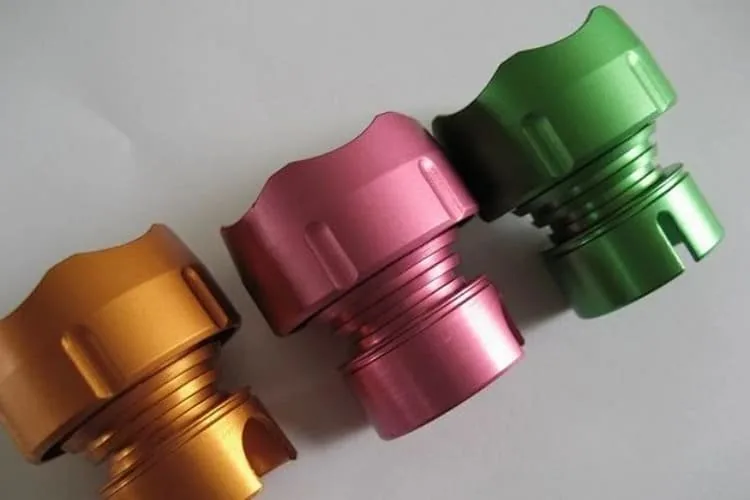
- Colour goes into the pores. Standard anodising is dyed, which is why the palette skews to black, clear, blue, red and gold — and why a dyed part can fade under strong UV over time.
- It keeps the metal look. Tool marks, grain direction and the odd handling scratch stay visible. If the part has to look perfect, the surface has to be right before it goes in the tank.
- Hard anodising is a different animal. Thicker and much harder, used on wear surfaces and sliding faces. It comes out grey to dark brown, not dyed bright, and it makes dimensions move more.
What powder coating actually does
Powder is a dry polymer sprayed electrostatically onto the part and then baked. It melts and flows into a continuous film — a skin, not a conversion.
- It hides everything. Sixty microns or more covers tool marks, small dents and colour variation between parts. This is why it is the default for covers, panels, guards and anything a customer looks at.
- Any colour you want. RAL and custom matches are routine, gloss levels too, and the batch-to-batch match is usually better than dyed anodising.
- It fails by chipping. A sharp knock on an edge can break the film and expose bare metal. Rounded edges and a good pre-treatment reduce this a lot.
- It does not like recesses. Faraday cage effects leave deep slots, blind holes and inside corners thin or bare. If a deep pocket has to be covered, say so — sometimes the answer is a different racking position, sometimes it is a different finish.
Where each one wins
- Pick anodising when the part slides, wears, or has to hold a dimension — bearing bores, sliding faces, datum surfaces, anything with threads that must stay within class.
- Pick powder coating when appearance is the point — enclosures, covers, panels, brackets that a customer sees, and parts where small surface imperfections need to disappear.
- Pick hard anodising when a wear surface is the problem rather than looks.
- Pick neither when the part needs electrical contact or grounding — mask those faces, and say which ones on the drawing.
What this means for your drawing
Most coating problems are decided before the part is cut. Four things are worth putting on the drawing:
- Allowance for the coating. If a shaft has to fit a bore after coating, either machine the shaft undersize or call out the finished dimension after coating.
- Which faces are masked. Threads, precision bores, grounding pads and datum faces are usually masked. Naming them costs one note and saves a rework loop.
- Surface finish before coating. A brushed or bead-blasted surface under clear anodise looks deliberate; a part with visible chatter will still show it.
- Colour reference. A RAL number or a sample is worth more than a name — “black” means different things to different shops.
None of this needs to be perfect. If you are not sure which finish suits the part, send the drawing with what the part has to do and survive, and we will say what we would use and why. Finishing runs on the same order as the machining, so there is no second supplier to coordinate — see surface finishes for the full list, or CNC machining aluminium for the material side.
Frequently asked questions
Does anodising change the dimensions of my part?
Yes, slightly. About half the layer thickness builds outward, so a 10 µm anodic layer adds roughly 5 µm per surface. That is usually irrelevant on a bracket and relevant on a bore or a shaft that has to fit something. Tell us which dimensions have to hold after finishing and we will allow for it in the machining.
Do threads need masking?
Usually yes. Coating builds up on the thread flanks and can make a gauge or a bolt tight. Masking tapped holes, or chasing them afterwards, is routine — put it on the drawing and it gets done without a discussion.
Can you match an existing colour?
For powder coating, yes — send a RAL number or a sample and it can be matched. For anodising the palette is narrower and dyed colours vary a little between batches and between alloys, so an exact match across two separate orders is harder. If colour continuity matters, powder is the safer choice.
Which is more durable outdoors?
Both hold up outdoors when they are done properly. Powder film is thicker and covers more, but a chip exposes bare metal. Anodising cannot chip, but a dyed colour can fade under strong UV. For long outdoor exposure, ask for the finish specified to the environment rather than picking by habit.
Can you coat parts that also need electrical contact?
Both finishes insulate, so contact faces have to be masked or machined after coating. Mark them on the drawing — a grounding pad that has to stay bare is easy to mask and awkward to fix later.
Is finishing done in-house or sent out?
It runs on the same order as the machining, so you do not have to coordinate a second supplier or ship parts yourself. Send the drawing with the finish you want and we quote the whole job — machining and finishing together.
Send the drawing
Send a STEP, IGES or DWG model with a dimensioned PDF, the material, the quantity and your target date. If you are not sure which finish the part needs, say what it has to do and survive and we will recommend one. You get a priced quote within 48 hours in the normal case, with tolerance and lead time stated on it.