Quick answer
Choose 6061-T6 unless you actually need the strength of 7075-T6. For most CNC machined parts — machine frames, fixtures, brackets, enclosures, heat sinks — 6061-T6 machines faster, costs less, welds properly, anodizes beautifully, and resists corrosion better. Move to 7075-T6 when a part is genuinely strength-critical: robot arm links, heavily loaded joints, thin walls that cannot be thickened, or aerospace-grade structural parts.
The price gap is real: 7075 typically runs 30–50% more per kilogram for raw stock, and it is harder on tools. Paying that premium for a bracket that sees modest load is money thrown away.
Side-by-side comparison
| Property | 6061-T6 | 7075-T6 |
|---|---|---|
| Tensile strength | 310 MPa (45 ksi) | 572 MPa (83 ksi) |
| Yield strength | 276 MPa (40 ksi) | 503 MPa (73 ksi) |
| Shear strength | 207 MPa (30 ksi) | 331 MPa (48 ksi) |
| Hardness (Brinell) | 95 | 150 |
| Elongation at break | 12% | 11% |
| Density | 2.70 g/cm³ | 2.81 g/cm³ |
| Machinability | Excellent | Good |
| Weldability | Excellent | Poor — not recommended |
| Corrosion resistance | Excellent | Fair — usually needs protection |
| Anodizing | Excellent, clear & dyed | Good, but colour can be uneven |
| Relative material cost | 1.0× | 1.3–1.5× |
1. Strength — where 7075 genuinely wins
7075-T6 has roughly 1.8× the yield strength of 6061-T6. If your part fails a stress calculation in 6061, switching to 7075 is often the fastest fix — no geometry change, no tooling change, just a different material callout.
That matters in specific places:
- Robot and automation links — arms, wrist plates, end-effector brackets where every gram counts and deflection ruins repeatability.
- Thin-walled structural parts — where you cannot add rib or thickness because of envelope limits.
- Highly loaded joints — clevises, lugs, and pin bosses that see cyclic loads.
- Aerospace-style fittings — the classic 7075 application.
But note the trade-off: 7075 achieves that strength through zinc alloying, and zinc is exactly what hurts its corrosion resistance and weldability.
2. Machinability — 6061 is noticeably easier
6061-T6 is one of the friendliest alloys a machine shop can work with. It cuts cleanly, chips break well, and it holds tolerances without fighting you. In practice this means:
- Higher feed rates and speeds — cycle times come down.
- Longer tool life — less time lost to tool changes.
- Better surface finish — often reachable without a finishing pass.
- Less scrap risk — 6061 is more forgiving on thin walls and deep pockets.
7075 is harder and more abrasive. It machines acceptably, but tools wear faster and thin sections are more prone to distortion as internal stress releases. That extra machining time is a hidden cost stacked on top of the material premium.
3. Corrosion — 6061 is the safe default
6061 forms a stable oxide layer and holds up well in humid, outdoor, and marine-adjacent environments, even bare. 7075 is significantly more susceptible to stress corrosion cracking and general attack, especially in the T6 temper.
If a 7075 part will see moisture, salt, or chemicals, budget for protection — anodizing or a conversion coating is not optional, it is required. That adds cost and lead time that a 6061 part would not need.
4. Weldability — often the deciding factor
6061 welds well. 7075 essentially does not. This is the single clearest separator between the two.
If your design is welded — a machine frame, a tank, an assembly of gussets and plates — 7075 is off the table. Attempting it leads to cracking in the heat-affected zone and a joint that cannot be trusted. 6061 can be welded with standard filler (4043 or 5356) and, if needed, re-heat-treated locally.
For bolted or fully monolithic designs, this constraint disappears and 7075 becomes viable.
5. Anodizing and appearance
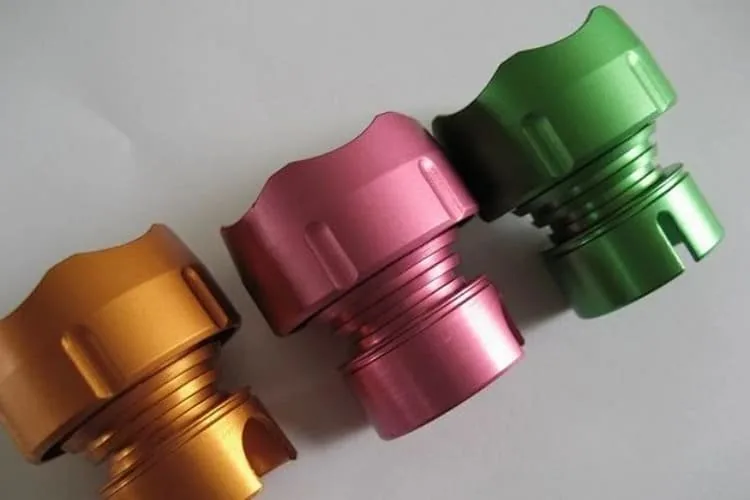
6061 anodizes to a clean, uniform finish and takes dye evenly — it is the standard choice when appearance matters: consumer-facing enclosures, panels, and anything colour-matched.
7075 can be anodized, and in fact takes hard anodize (Type III) very well for wear resistance. But clear and dyed cosmetic finishes tend to come out less uniform, sometimes with a slightly grey or mottled cast. If the part is visible and colour matters, 6061 is the safer call.
6. What it actually costs
The material premium is only part of the picture. A realistic comparison for an identical part:
| Cost factor | 6061-T6 | 7075-T6 |
|---|---|---|
| Raw stock | Baseline | +30–50% |
| Machining time | Faster | Slower (harder alloy) |
| Tool wear | Low | Higher |
| Finish required? | Usually optional | Usually required |
| Scrap / distortion risk | Low | Higher |
Stacked together, a 7075 part can easily land at 1.5–2× the unit cost of the same part in 6061. That is fine when strength demands it — and wasteful when it does not.
Choosing by application
| Application | Recommended | Why |
|---|---|---|
| Machine frames and base plates | 6061-T6 | Weldable, stiff enough, cost-effective |
| Jigs, fixtures, and tooling plates | 6061-T6 | Stable, easy to modify, anodizes well |
| Enclosures and housings | 6061-T6 | Cosmetic anodizing, corrosion resistance |
| Heat sinks | 6061-T6 | Good thermal conductivity, easy to machine fins |
| Robot links, high-load brackets | 7075-T6 | Strength-to-weight is worth the premium |
| Thin-wall structural parts | 7075-T6 | Cannot add thickness; need the strength |
| Marine or outdoor hardware | 6061-T6 | Corrosion resistance without extra coating |
| Cosmetic consumer parts | 6061-T6 | Uniform dyed anodize |
Design tips that lower cost in either alloy
Whichever you pick, these geometry decisions usually move the quote more than the alloy does. (More on our aluminium CNC machining capabilities.)
- Use the largest corner radius the design allows. Small radii force small tools, and small tools mean many slow passes.
- Avoid unnecessarily tight tolerances. Holding ±0.01 mm everywhere costs far more than specifying it only on critical features.
- Keep wall thickness uniform where possible — it reduces distortion, especially in 7075.
- Design pockets with standard cutter sizes in mind. A 6 mm radius pocket finishes far faster than a 2 mm one.
- Ask for a drawing review before you commit. If a feature cannot be machined as drawn, or costs more than it needs to, that is when you hear about it — otherwise the part is quoted as-is.
Frequently asked questions
Is 7075 worth the extra cost?
Only when the part is strength-limited. If your design passes its stress check in 6061 with a reasonable safety factor, 7075 buys you nothing but a higher invoice. If it fails, 7075 is usually cheaper than redesigning the whole assembly.
Can 7075 be welded?
It is not recommended. 7075 is generally considered non-weldable for structural purposes — the heat-affected zone loses strength and is crack-prone. Design 7075 parts to be bolted or machined from solid.
Which alloy anodizes better?
6061 for appearance — it gives a clean, even, dye-friendly finish. 7075 for wear resistance — it takes hard anodize (Type III) well, though cosmetic colours can look uneven.
What about 6082, 2024, or 5083?
6082-T6 is the European near-equivalent of 6061 and is a good substitute when it is what is locally stocked. 2024-T3 has excellent fatigue resistance and is common in aerospace skins, but poor corrosion resistance. 5083 is a non-heat-treatable marine alloy with outstanding corrosion resistance — the right choice for saltwater exposure. If your drawing names an alloy you are unsure about, send it over and we will confirm what is actually achievable.
What tolerances can you hold on aluminium?
As a general guide we work to ISO 2768-m, with tighter tolerances on critical features where the geometry allows — down to ±0.005 mm on specific dimensions. The key is marking which dimensions genuinely matter; blanket tight tolerances across a drawing drive cost up without improving function.
Get a quote from your drawing
Send us your STEP, IGES, or PDF drawing and we will return a quote within 48 hours in the normal case, and we will tell you plainly whether 6061 or 7075 is the right call for your part. If something on the drawing cannot be machined as drawn, you hear about it before tooling, not after.
There is no minimum order quantity: one prototype or a production run, quoted case by case.