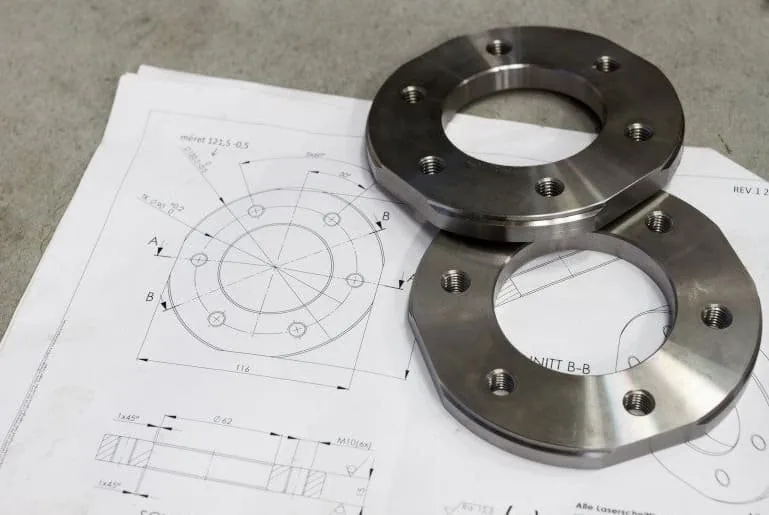
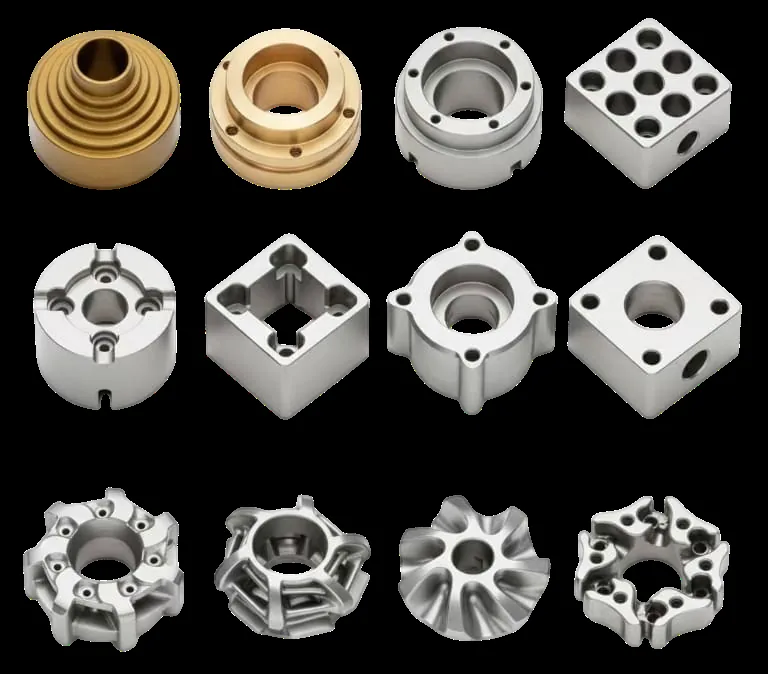
Quick answer: Titanium costs more for four reasons that stack: the stock is expensive before anything is cut, heat stays in the tool instead of leaving with the chip, cutting speeds stay low and tools wear fast, and the metal is springy enough that holding a thin wall to size takes real work. None are surcharges — they are physics. What you can change is how much titanium is in the part and how much has to be machined away.
Almost everyone asks the same follow-up: why does this cost three or four times the same geometry in aluminium? It takes longer, wears tools faster and needs more attention per part — and some of that cost is unavoidable while some is a design decision.
The short version
| Cost driver | What actually happens | How much you can influence it |
|---|---|---|
| Raw material | Stock costs far more per kilogram, and more of it ends up as swarf | High — near-net shape, smaller envelope |
| Cutting speed | Speeds stay a fraction of aluminium’s | Low — set by the alloy |
| Tool life | Heat concentrates at the edge; tools are changed mid-job | Medium — generous radii and stable cuts help |
| Workholding | Low stiffness means springback, deflection and chatter | High — wall and rib design decide it |
| Inspection | Usually functional parts carrying real tolerances | Medium — tighten only fit-critical dimensions |
The raw material is expensive before the machine starts
Titanium stock costs substantially more per kilogram than aluminium or mild steel, and the gap is wider for aerospace grades. That part of the cost nobody can machine away.
The second half is how much of that billet leaves as chips. A part that starts as solid bar and finishes as a thin-walled housing sends most of the material out as swarf, and titanium swarf recovers little of what the bar cost. Two moves do most of the work: start closer to the finished shape, and do not over-specify the envelope — a larger block costs twice, once in stock and once in the time to remove the difference.
Heat goes into the tool instead of the chip
Titanium has poor thermal conductivity. In aluminium or steel, much of the heat at the cutting edge leaves with the chip. In titanium it does not — it stays concentrated in a very small area right at the tool tip.
The edge therefore sees temperatures that break it down quickly, and the surface can be damaged if the cut is not managed. In practice: sharp tools changed on a schedule rather than on failure, coolant delivered where the cut is — high-pressure through-tool coolant helps most — and toolpaths that keep the load steady instead of spiking at corners.
Titanium is also chemically reactive at temperature, which is why tool material and coating choice matter more here than for most engineering metals.
Tool life, and what it does to cycle time
Low speed and short tool life compound. When the spindle cannot run fast and the cutter must be swapped several times through one part, cycle time stretches regardless of operator efficiency — it is what the alloy allows.
This is also why titanium quotes are more geometry-sensitive than aluminium ones. A pocket with a generous corner radius can be cut with a larger, stiffer tool at a better feed; the same pocket with a sharp internal corner needs a small cutter, more passes and more time. The drawing settles that before the CAM does.
Workholding, thin walls and deflection
Titanium has a relatively low modulus of elasticity — it is springier than steel. Under cutting pressure a thin wall deflects away from the tool and springs back, which produces taper, chatter and dimensions that drift across a batch.
On a part with thin walls and deep pockets, controlling this can take longer than the cutting: extra finishing passes, lighter cuts, custom fixtures, sometimes several setups to reach and support the feature. Wall thickness is the biggest lever over titanium cost, and it is nearly always decided before the drawing reaches a machine shop.
Grade 5 vs Grade 2: two very different jobs
Not all titanium machines alike, and the grade on the drawing changes the quote.
- Grade 5 (Ti-6Al-4V) is the common structural alloy — strong, heat-treatable, specified on most aerospace, motorsport and high-performance industrial parts. It also demands the most from tooling.
- Grade 2 is commercially pure: softer, more corrosion-resistant, but gummy — it builds up on the cutting edge rather than forming clean chips.
- Grade 23 (Ti-6Al-4V ELI) is the extra-low-interstitial variant, specified where fracture toughness or biocompatibility matters.
If the drawing just says “titanium”, the quote is a guess. If it says Grade 5 out of habit where Grade 2 would do the job, that is worth confirming before the order.
Where you can take cost out — and when titanium is worth it anyway
| Design lever | Effect on cost | What it costs you |
|---|---|---|
| Increase wall thickness | Large — fewer finishing passes, less deflection | Weight |
| Generous internal corner radii | Large — bigger, stiffer cutters, faster feeds | Some internal geometry |
| Reduce overall envelope | Large — less stock, less material to remove | Whatever the size was for |
| Limit deep pockets | Medium — shorter tools, less chatter | Design freedom |
| Tighten tolerances only where needed | Medium — less inspection and fewer rework loops | Nothing, if chosen carefully |
| Specify the grade deliberately | Medium — avoids machining a harder alloy than required | Nothing, if the grade was habitual |
Sometimes the honest answer is that titanium is the right material and the cost is the cost. It earns its place when you need the strength-to-weight ratio, when the part sees temperatures that rule out aluminium, when corrosion resistance in a hostile environment matters more than the price gap, or when the weight saving is worth paying for. It is usually the wrong call when the only requirement is “strong” — a stainless or alloy steel will be stronger and cheaper.
Most titanium work runs on 3-axis and 5-axis milling and CNC turning, with 5-axis machining used where the geometry would otherwise need several setups — fewer setups means fewer chances to lose a dimension on a part that is expensive before it is finished. Intricate profiles and narrow slots may go to wire EDM, which holds ±0.01 mm and ±0.005 mm on high-precision work, and consistent size across a batch is finished by grinding down to ±0.002 mm. Full ranges sit on the CNC machining tolerances page; the grades we work with are on the CNC machining titanium page.
Frequently asked questions
Why is my titanium quote so much higher than the same part in aluminium?
Four things stack: the stock costs far more per kilogram, cutting speeds are much lower, tools wear out faster and must be changed mid-job, and thin sections deflect in ways that need extra passes. More of an expensive billet also ends up as chips.
Is Grade 5 (Ti-6Al-4V) always the right choice?
It is right when you need the strength and fatigue properties it is specified for. Grade 2 is commercially pure, more corrosion-resistant and often easier to justify on lightly loaded parts. Confirm the requirement if Grade 5 was specified out of habit.
Can you machine thin-wall titanium parts?
Yes, but cost and risk rise as walls get thinner, because titanium deflects under cutting pressure and springs back. Generous radii, moderate wall thickness and sensible pocket depth make a large difference. If thin walls are unavoidable, say so up front.
Does titanium need a surface treatment?
Often not — titanium forms its own protective oxide and is frequently used bare or bead blasted. Anodising is used for colour coding and wear surfaces rather than corrosion protection. Note any cosmetic or wear requirement on the drawing.
Can you hold tight tolerances in titanium?
Yes, within the same ranges as other materials — ±0.01 mm on fit-critical features is routine. What differs is the cost of getting there. Tighten what controls a fit or seal and leave the rest on the general ISO 2768-m tolerance.
How long does a titanium order take?
Standard lead time is 2–4 weeks, covering machining, any finishing and inspection. Rush orders are confirmed case by case — depending on grade, stock availability and the queue. Parts ship from Guangdong. Send the drawing with your target date and we will say what is realistic.
Send the drawing
Send a STEP, IGES or DWG model with a dimensioned PDF, the grade, the quantity and your target date. If you are weighing titanium against aluminium or steel, send the same drawing for both and we will price them side by side so the comparison is real rather than assumed. We review every drawing before quoting, and if we see a feature that cannot be machined as drawn, or one that adds cost without adding function, we point it out and suggest an alternative for you to confirm. You get a priced quote within 48 hours in the normal case, with tolerance and lead time stated on it. Start on the contact page, or see prototyping and low-volume production if you would rather have one part machined first.