Rapid Prototyping & Low-Volume Production
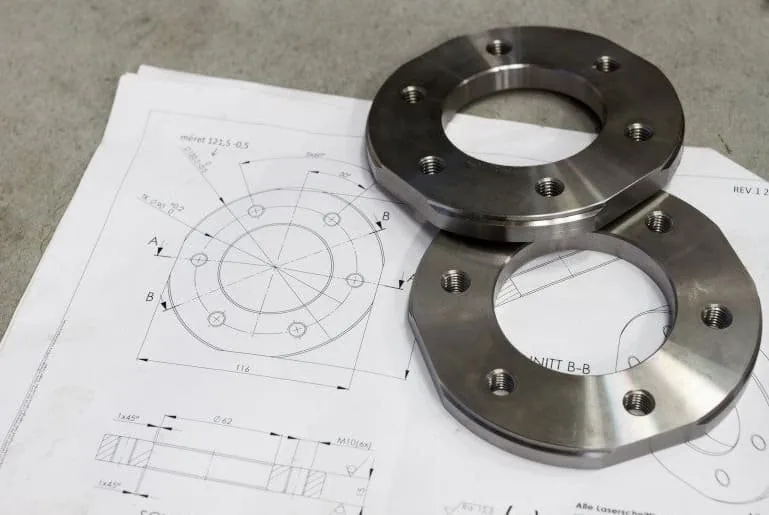
From one-off prototypes to 500-piece runs, machined from the same material and to the same tolerances as your production parts — not a stand-in resin or a softer substitute.
- No minimum order quantity
- Prototypes from 5–7 working days
- Same material as production
Quick answer
Prototyping and low-volume production on CNC equipment means your parts are cut from the same material and by the same processes as the eventual production parts. That matters because material behaviour is often the thing a prototype is meant to test. A bracket printed in plastic tells you about fit; the same bracket cut from 6061-T6 tells you about fit, stiffness and how it will anodise.
We quote within 48 hours in the normal case, accept quantities from one upwards, and there is no minimum order value.
Prototype vs. low volume vs. production
The jump from prototype to low volume is mostly about fixturing and documentation, not about changing the process.
| Stage | Typical quantity | What it is for | How we approach it |
|---|---|---|---|
| Prototype | 1 – 10 | Fit check, design validation, customer samples | Machined from solid, full material, full tolerance, minimal fixturing |
| Pilot / pre-production | 10 – 50 | Assembly trials, field testing, first customer deliveries | Simple fixtures made so parts are repeatable; first article inspected |
| Low-volume production | 50 – 500 | Selling product, spare parts, seasonal demand | Dedicated setup documented so reorders match; consistent finish applied |
| Ongoing production | 500+ | Regular demand | Scheduled runs with agreed batch sizes and inspection sampling |
Why machine prototypes instead of printing them
Additive manufacturing wins on internal lattices and organic shapes. For almost everything else, machining wins.
- Real material properties — strength, stiffness, thermal expansion and wear behaviour match the production part.
- Real tolerances — fits, bearing seats and sealing faces can be tested, not estimated.
- Real finishes — anodising, plating and bead blasting can be applied and evaluated on the prototype.
- No design compromises — no draft angles, no support marks, no layer lines.
- Scales without redesign — the same program runs for quantities of 1 or 500.
Capability
What we run for prototype and low-volume work.
Minimum Quantity
1 piece
No minimum order value.
Prototype Lead Time
Confirmed per order
Standard window is 2–4 weeks; simple parts and rush orders are quoted case by case.
Low Volume Lead Time
2 – 4 weeks
Standard window for most production orders.
Files Accepted
STEP · IGES · DWG
STEP with a dimensioned PDF is ideal.
What actually drives prototype cost
Four things move the number more than anything else.
- Material — 6061 aluminium and 1018 steel are the cheapest to buy and quickest to cut. Titanium and PEEK cost more as stock and take longer in the machine.
- Number of setups — a part finished in one or two setups is dramatically cheaper than one needing five, and each extra setup adds a small stack-up of positional error.
- Tolerance — ISO 2768-m is included in the base price. Tighter callouts mean slower passes, more inspection, and sometimes a different process entirely.
- Quantity — the first part carries programming and setup. Parts two to twenty mostly carry machine time, which is why the per-unit price drops sharply between one and ten.
How a first order runs
- You send files. STEP or IGES plus a PDF with tolerances, material and quantity. We sign an NDA first if you want one.
- Quote within 48 hours in the normal case. Price, lead time and any manufacturability notes — including suggestions that reduce cost without changing function.
- First article on new designs. For quantities above ten we recommend making one piece first, checking it, then releasing the batch.
- Production run. Machined, finished and inspected. Inspection reports available on request.
- Reorders. Programs and setups are retained, so repeat orders match the original parts and usually ship faster.
Design tips for prototypes and small batches
Changes that are free now and expensive after tooling exists.
- Machine from solid where possible. For quantities under about 50, solid stock almost always beats a casting or extrusion plus machining, because there is no tooling to pay for.
- Use stock sizes. Designing a plate at 12 mm instead of 12.7 mm means slicing a thick block, and the offcut is billed.
- Keep tolerances functional. ±0.01 mm on a mounting face costs nothing extra; ±0.01 mm on every dimension requires extra setups and inspection.
- Standardise hole sizes. Every different drill size is a tool change — using three sizes instead of eight shortens the run noticeably.
- Think about the second order now. Tell us if this is likely to repeat and we will document the setup rather than re-solving it next time.
Frequently Asked Questions
Answers to the questions we get asked most about this process.
Is there a minimum order quantity?
No. One piece is fine. Pricing per part naturally improves with quantity because setup cost is spread across more units.
How fast can I get a prototype?
Simple aluminium or steel parts can ship sooner than the standard 2–4 week window, and rush orders are confirmed case by case — we put a date on your quote. Five-axis work, exotic materials and finishing add time. Tell us your deadline and we will say honestly whether it is achievable.
Will the production parts match my prototype?
Yes, if the design does not change. We retain the program and setup, and use the same material grade and finish specification.
Can you help refine the design for manufacture?
Yes. Every quote includes manufacturability comments where we see an easy saving — a radius that needs a smaller tool, a tolerance that is tighter than the function requires, a feature that needs a second setup.
What about cost at 50 or 100 pieces?
Ask for a quantity break. We price 1, 10, 50 and 200 in the same quote so you can see where the curve flattens before committing.
Which materials can you prototype in?
Aluminium, steel, stainless, titanium, brass, copper and engineering plastics — the same stock we use for production. See aluminium and engineering plastics for grade-level guidance.
Do you sign an NDA before I send drawings?
Yes, on request. We will sign before you send files.
Ready to Start Your Project?
Send drawings in STEP, IGES or DWG. You get a priced quote within 48 hours in the normal case, with tolerance and lead time stated up front.
If the drawing is still changing between revisions, see CNC machining for custom automation equipment.