Aluminum CNC Machining Service
Precision-engineered aluminium parts machined to your drawing — ISO 2768-m as standard, ±0.01 mm on the dimensions you mark as critical, and ±0.005 mm where the geometry allows. From one-off prototypes to low-volume production.
Comprehensive Aluminum Machining Services
Full-spectrum CNC machining capabilities for all your aluminum component needs.
3-Axis & 5-Axis CNC Milling
Complex geometries and intricate details machined with exceptional precision using advanced multi-axis CNC equipment.
- Complex contours
- Tight tolerances
- Surface finish Ra 0.8
CNC Turning Services
Precision cylindrical parts, shafts, and rotational components manufactured with high-speed CNC turning centers.
- Diameter up to 500mm
- Threading capabilities
- Live tooling available
Aluminum Prototyping
Rapid prototyping services to bring your designs to life quickly, with fast turnaround for testing and validation.
- 2–4 weeks · rush on request
- Design feedback
- Iterative development
High-Volume Production
Scalable manufacturing solutions for mass production with consistent quality and competitive pricing.
- 100K+ units/month
- Automated inspection
- Cost optimization
Related processes: features a cutter cannot reach are cut on our wire EDM machines; tight shaft and bore fits, and finishes finer than milling can hold, come from CNC grinding. If you want the geometry proven before a production run, start with rapid prototyping and low-volume production.
Why Choose Aluminum for Your Project
Aluminum offers numerous advantages for CNC machining applications across various industries.
Lightweight & Strong
Aluminum has a density of only 2.7 g/cm³, about one-third that of steel, while maintaining good strength properties.
Excellent Machinability
Aluminum's high machinability allows for faster cutting speeds, reduced tool wear, and lower production costs.
Corrosion Resistant
Aluminum naturally forms a protective oxide layer, providing excellent resistance to corrosion in various environments.
Superior Heat Dissipation
With a thermal conductivity of 205 W/m·K, aluminum is ideal for heat sinks and thermal management applications.
100% Recyclable
Aluminum is fully recyclable without loss of properties, making it an environmentally friendly choice.
Why Choose Our Aluminum CNC Machining
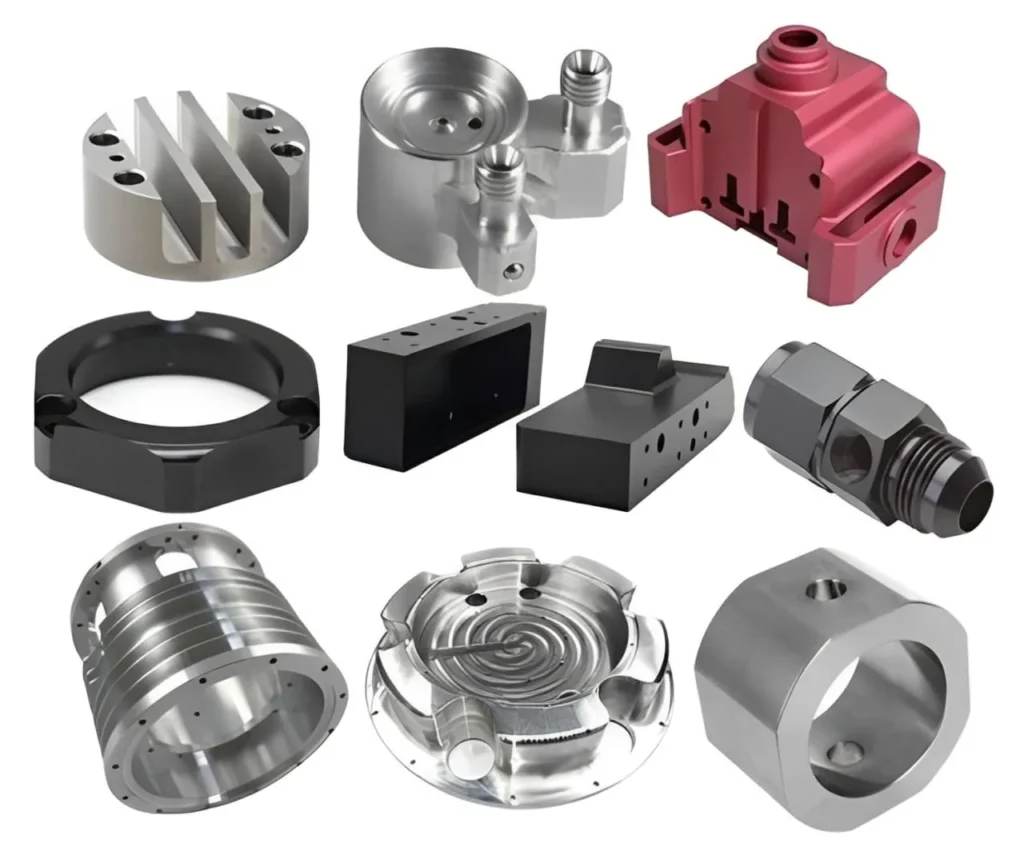
MetaliCNC provides high-precision aluminum CNC machining services backed by advanced technology and over a decade of manufacturing expertise.
High Precision
Tight tolerances up to ±0.01mm with advanced 5-axis CNC machines for complex geometries.
Quality Control
Documented inspection at every stage, with full traceability.
High Efficiency
Monthly output of 30,000+ aluminum parts with optimized production processes.
Expert Team
Engineers with 10+ years of CNC machining experience providing optimized solutions.
Aluminum Alloys We Work With
We specialize in machining various aluminum grades to meet your specific application requirements.
| Grade | Description | Tensile Strength | Yield Strength | Hardness | Common Applications |
|---|---|---|---|---|---|
| 6061 Aluminum | Most versatile aluminum alloy with good strength, corrosion resistance, and machinability. | 310 MPa | 276 MPa | 95 HB | Aircraft parts, automation components, electronic enclosures |
| 7075 Aluminum | High-strength aluminum alloy with excellent fatigue resistance. | 572 MPa | 503 MPa | 150 HB | Aerospace structures, high-stress components, bicycle frames |
| 2024 Aluminum | High-strength alloy with excellent fatigue resistance and good machinability. | 470 MPa | 325 MPa | 120 HB | Aircraft structures, wing skins, fuselage components |
| 5052 Aluminum | Non-heat treatable alloy with excellent corrosion resistance and formability. | 232 MPa | 193 MPa | 60 HB | Marine components, fuel tanks, electronic enclosures |
| 5083 Aluminum | High-strength, non-heat treatable alloy with excellent corrosion resistance. | 317 MPa | 276 MPa | 85 HB | Marine structures, pressure vessels, chemical equipment |
Other materials: see the dedicated pages for brass and copper, carbon and alloy steel, and engineering plastics.
Don’t see your specific requirement listed? Our engineering team can work with you on custom specifications, special materials, and unique finishing requirements.
Industries We Serve
Aluminium parts machined for automation, robotics, instrumentation and enclosure builders — mostly fixtures, housings, brackets and shafts.
Aerospace
Medical Devices
Industrial Automation
Electronics
Industrial Equipment
Energy & Renewables
How We Check Parts Before Shipment
Quality isn’t just a promise—it’s embedded in every step of our process. From material selection to final inspection, we maintain the highest standards to ensure your parts meet exact specifications.

Consistent Quality Control
Our quality management system ensures consistent excellence in every project.
Inspection Before Shipment
Every part undergoes rigorous inspection using CMM and optical measurement systems.
Complete Documentation
Full dimensional reports, material certificates, and traceability documentation included.
Inspection Records
Inspection records supplied with every order — ask for them when you request a quote.
Quality Guarantee
If any part doesn't meet specifications, we'll remake it at no additional cost. Your satisfaction is guaranteed.
Frequently Asked Questions
The questions we get asked before a first aluminium order.
Should I choose 6061 or 7075 aluminium?
6061-T6 for most parts — it machines fast, welds, anodises well and costs less. 7075-T6 when you need the strength: roughly double the yield of 6061, but it is not welded in service, it costs more, and it is less corrosion resistant, so it is usually anodised or painted. We also machine 6082 and 2024 on request. The two are compared in detail in our article on 6061 vs 7075 aluminium.
How tight a tolerance can you hold on aluminium?
ISO 2768-m on dimensions without a callout, ±0.01 mm on critical features as standard, and ±0.005 mm where geometry and material allow. Aluminium is stable and cuts quickly, so tight tolerances cost less than the same callout on steel or titanium — but every extra decimal still adds setups, slower finishing passes and inspection time.
Will thin-walled aluminium parts warp after machining?
They can. Large flat faces and walls under about 1 mm release stress when material comes off. We rough first, then finish, and add a stress-relief step where the geometry needs it. If your part has a thin floor or walls under 1 mm, tell us at quote stage and we will plan the sequence around it.
What surface finishes do you offer for aluminium?
Type II anodising (clear, black and colours), Type III hard anodising for wear surfaces, bead blasting, brushing, chromate conversion and powder coating. Finishing is arranged on the same order, so you receive one delivery rather than two. See the full list of surface finishes.
Can you machine to a pre-anodising dimension?
Yes. Anodising builds up roughly 5–25 µm per surface depending on the type and thickness, so a bore or a fit will close by that amount. We machine to the pre-plate dimension and confirm the build-up with you before the parts go out for finishing.
What is the minimum wall thickness you recommend?
0.5 mm is machinable on small aluminium features; 1.0 mm is safer for any wall that has to stay flat over length. Deeper cavities need more draft and a larger corner radius — R1 mm or more keeps the tool stiff and stops the wall from chattering.
What is your minimum order quantity and lead time?
There is no minimum — one piece is fine. Standard lead time is 2–4 weeks. Rush orders are confirmed case by case, so send your deadline with the drawings and we will say straight away whether we can hit it.
Ready to Start Your Aluminum CNC Project?
Get an instant quote or speak with our engineering team to discuss your requirements.
Aluminium robot tooling — gripper bodies, adapter plates, sensor brackets — is covered on the robotics page.